Haaretz Interview
September 8th 2024
 https://www.haaretz.co.il/gallery/art/2024-09-08/ty-article/.premium/00000191-c20c-dd1b-a7db-f7de822f0000?utm_source=Web_Share&utm_medium=Whatsapp&utm_campaign=Share
Dana Levy: “I love that it’s delusional. That you don’t understand how it was created.”
https://www.haaretz.co.il/gallery/art/2024-09-08/ty-article/.premium/00000191-c20c-dd1b-a7db-f7de822f0000?utm_source=Web_Share&utm_medium=Whatsapp&utm_campaign=Share
Dana Levy: “I love that it’s delusional. That you don’t understand how it was created.”
Dana Levy, a successful video artist in the US, is presenting a new exhibition in Tel Aviv about a beautiful and run-down area in St. Louis. How does this relate to her work on the Green Line that was shown at the Tel Aviv Museum and how she is dealing with the threat of AI?
Naama Riva
“I saw levels of poverty in the United States that I haven’t seen anywhere else in the world. I think the poor in East Asia eat better, because at least they eat non-industrial food. The poor in the US are dying of obesity,” says video artist Dana Levy, in a conversation about her video work, which is on display in the “Invasions” exhibition at the Braverman Gallery in Tel Aviv.
Levy, who has been working in New York for the past 14 years, is part of a group of Israeli video artists, including Nira Pereg, Guy Ben Ner, and Yael Bartana, who have been embraced by the global art world for the past two decades. She has exhibited around the world: at the Berlin Biennale, the Bass Museum in Miami, galleries in San Francisco and New York, the Tel Aviv Museum, and the Israel Museum. Levy was born in Israel to parents of Egyptian and German descent, grew up in the US, Israel, and Britain, and she refuses to say her age (but notes that what appears online is not true).
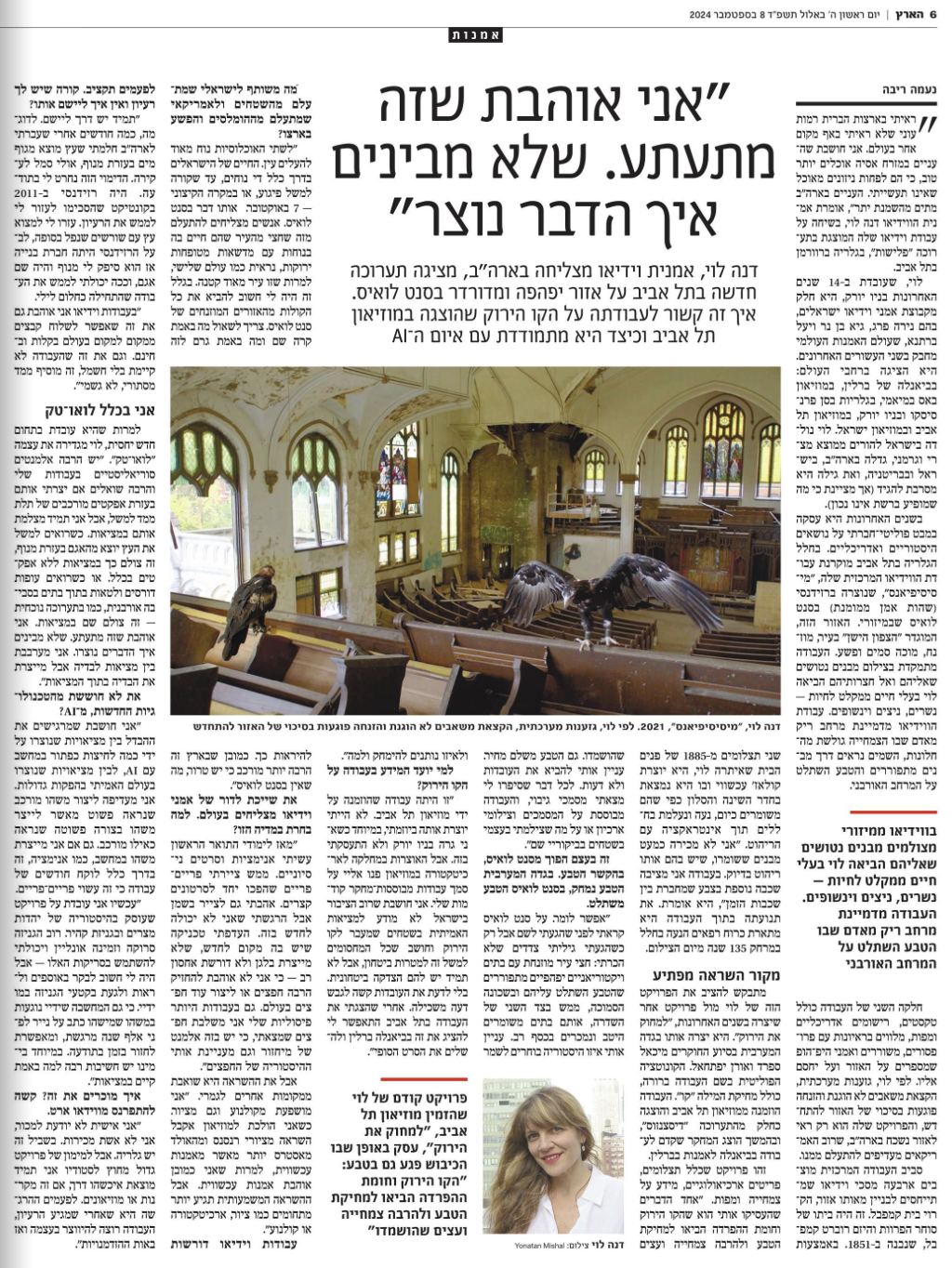
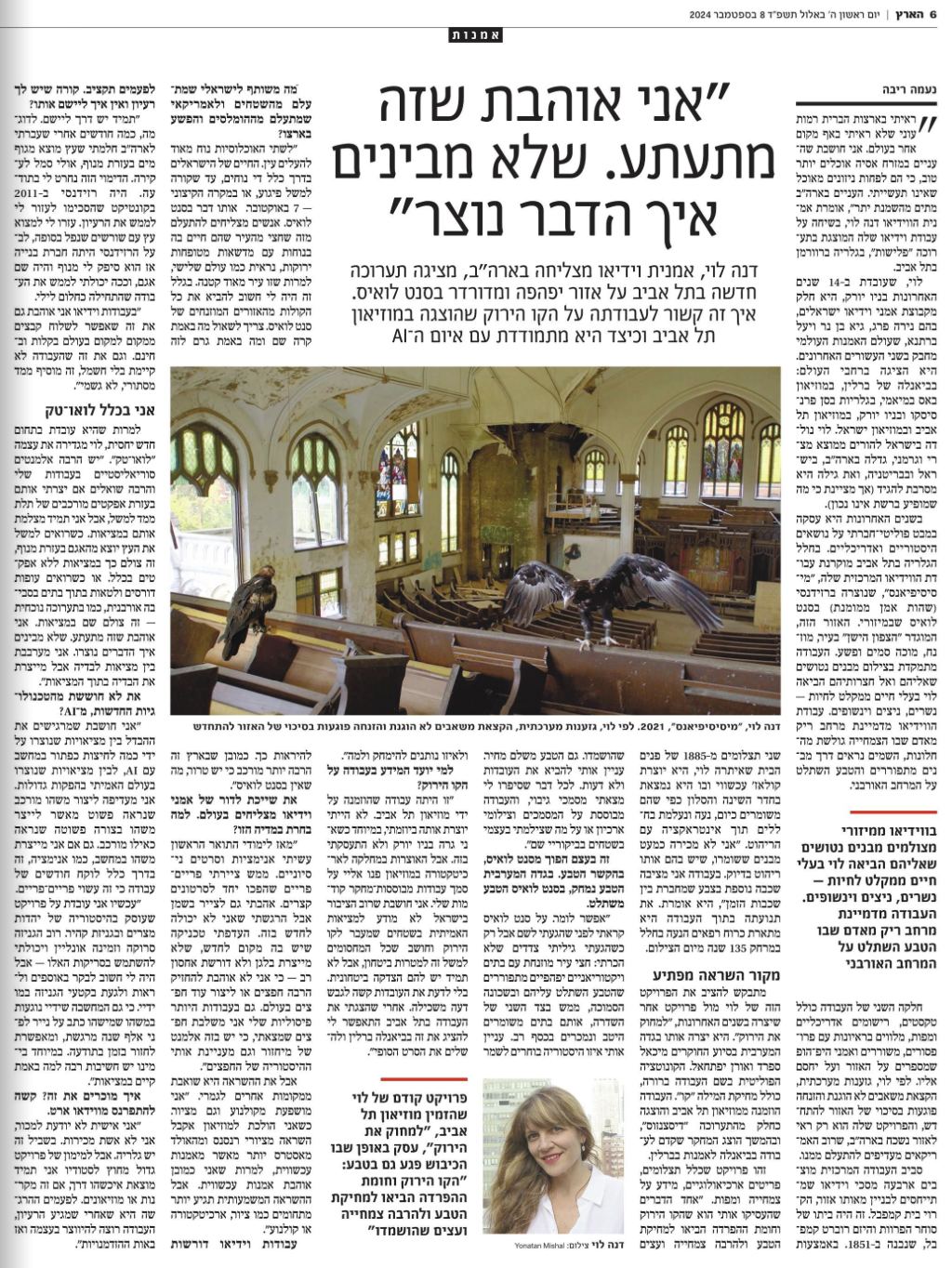
In recent years, she has been engaged in a socio-political perspective on historical and architectural issues. The gallery space in Tel Aviv is showing her main video work, “Mississippiens,” created during a residency (a funded artist residency) in St. Louis, Missouri. This area, defined as the “Old North” of the city, is neglected, plagued by drugs and crime. The work focuses on photographing abandoned buildings to which and into whose yards Levy brought animals from an animal shelter—eagles, hawks, and owls. The video work imagines a space empty of people where vegetation flows from the windows, the sky is visible through crumbling buildings, and nature has taken over the urban space.
The video from Missouri imagines a space empty of people where nature has taken over the urban space.
The second part of the work includes texts, architectural drawings and maps, accompanied by interviews with professors, poets and hip-hop artists who talk about the area and their relationship to it. According to Levy, systemic racism, unfair allocation of resources and neglect harm the area’s chances of renewal, and her project is just a mirror to a forgotten area in the US, which most Americans prefer to ignore.
Around the central work are four video screens that refer to a building from the same area, called the Campbell House. It was the home of fur trader and entrepreneur Robert Campbell, built in 1851. Using two 1885 photographs of the interior of the house that Levy located, she creates a contemporary collage in which she is in the bedroom and living room as they are preserved today, moving and disappearing in the spaces while interacting with the furniture. “I know of almost no buildings that have been preserved that have the exact same furniture. In the work, I place another layer of color that connects the layers of time,” she says. She describes her movement within the work as a ghost moving through space 135 years from the date of the photograph.
A surprising source of inspiration
It is necessary to place this project by Levy in contrast to another project she has created in recent years, “Erasing the Green.” She created it in the West Bank with the assistance of researchers Michael Sfard and Oren Yiftachel. The political connotation of the work’s name is clear, including the deletion of the word “line.” The work was commissioned by the Tel Aviv Museum and exhibited as part of the “Discensus” exhibition, and the research that preceded the work was later presented at the Berlin Art Biennale.
This is a project that included photographs, archaeological items, information about vegetation, and maps. “One of the things that concerned me was that the Green Line and the separation wall led to the erasure of nature and a lot of vegetation and trees that were destroyed. Nature also pays a price. I was interested in bringing the facts, not opinions. For everything I was told, I found supporting documents, and the work is based on the documents and archival photographs or on what I myself photographed in the territories during my visits there.”
It’s actually the opposite of St. Louis, in terms of nature. In the West Bank, nature is erased, in St. Louis, nature takes over.
“You could say. I read about St. Louis before I got there, but it wasn’t until I arrived that I discovered sides I didn’t know about: half the city is neglected with beautiful, crumbling Victorian houses that nature has taken over, and in the neighboring neighborhood, right on the other side of the avenue, the same houses are well preserved and are being sold for a lot of money. I was interested in what history they choose to preserve and what they let be erased, and why.”
Who is the information intended for in the work on the Green Line?
“It was a work commissioned by the Tel Aviv Museum. I wouldn’t have created it on my own initiative, especially when I was living in New York and wasn’t involved in it. But the curators in the architecture department at the museum approached me based on my previous research-based works. I think that most of the Israeli public is unaware of the true reality in the territories beyond the Green Line and thinks that all the checkpoints, for example, are for security purposes, but they don’t always have a security justification. Without knowing the facts, it’s difficult to form an educated opinion. After I presented the work in Tel Aviv, I was able to present it at the Berlin Biennale and complete the final film.”
What do an Israeli who ignores the territories and an American who ignores the homeless and crime in his country have in common?
“Both populations find it very convenient to turn a blind eye. Israelis’ lives are usually quite comfortable, until, for example, a terrorist attack happens, or in the extreme case, October 7th. The same thing in St. Louis. People manage to ignore the fact that half of the city they live in comfortably with green manicured lawns looks like a third world country, even though it’s a very small city. That’s why it was important to me to bring all the voices from the neglected areas of St. Louis. We have to ask what really happened there and what really made it look that way. Of course, in Israel it’s much more complicated because there is terrorism, which St. Louis doesn’t have.”
You belong to a generation of successful video artists in the world. Why did you choose this medium?
“Since my undergraduate studies, I’ve been making animations and experimental films. I literally drew frame-by-frames that turned into short videos. I also loved painting in oil, but I felt like I couldn’t innovate with it. I preferred a technique that had room for innovation, that didn’t create a mess and didn’t require a lot of storage — because I don’t like to have a lot of objects or create more objects in the world. Even in my more sculptural works, I incorporate objects that I found, because there’s an element of recycling in it and I’m also interested in the history of the objects.”
But she draws her inspiration from completely different places. “I’m influenced by cinema and painting. When I go to a museum, I’ll be inspired by Renaissance paintings and the Old Masters more than by contemporary art, although of course I love contemporary art. But the significant inspiration will come more from fields like painting, architecture or cinema.”
Video work sometimes requires a budget. Do you have an idea and no way to implement it?
“There is always a way to implement. For example, a few months after I moved to the US, I dreamed that a tree was being lifted out of a body of water with the help of a crane, perhaps a symbol of uprooting. This image was etched in my mind. There was a residency in Connecticut in 2011 that agreed to help me realize the idea. They helped me find a tree with roots that had fallen in a storm. The owner of the residency had a construction company, so he provided me with a crane and there was a lake there, and that’s how I was able to realize the work that began as a nighttime dream.
“In video work, I also like the fact that you can send files from one place to another in the world easily and for free. And the fact that the work doesn’t exist without electricity, it adds a mysterious, non-material dimension.”
I’m generally low-tech.
Although she works in a relatively new field, Levy defines herself as “low-tech.” “There are many surreal elements in my work, and many people ask if I created them using complex 3D effects, for example, but I always film them in reality. For example, when you see the tree coming out of the lake with a crane, it was filmed in reality without any effects at all. Or when you see birds of prey and lizards inside houses in an urban environment, like in a current exhibition — it was filmed there in reality. I like that it’s deceptive. That you don’t understand how things were created. I mix reality with fiction, but I create the fiction within reality.”
Aren’t you afraid of new technologies, of AI?
“I think you feel the difference between realities created by a few button presses on a computer with AI, and realities created in the real world in large productions. I prefer to create something complex that looks simple than to produce something simple that looks complex. Even if I produce something on a computer, like animation, it usually takes months of work because it’s done frame by frame.
“I’m currently working on a project that deals with the history of Egyptian Jewry and the Cairo Genizah. Most of the Genizah is scanned and available online, and I was able to use these scans — but it was important to me to visit the collections and see and touch the Genizah fragments with my own hands. Because even the thought of my hands touching something that someone wrote on paper a thousand years ago is exciting, and allows me to go back in time in my mind. Especially nowadays, what really exists in reality is of great importance.”
How do you sell it? It’s hard to make a living from video art.
“I personally don’t know how to sell, I’m not a saleswoman. That’s what a gallery is for. But for financing a large project outside the studio, I always somehow find a way, whether it’s from foundations or museums. Sometimes the feeling is that after the idea comes, the work wants to be created on its own, and then the opportunities come.”
 https://www.haaretz.co.il/gallery/art/2024-09-08/ty-article/.premium/00000191-c20c-dd1b-a7db-f7de822f0000?utm_source=Web_Share&utm_medium=Whatsapp&utm_campaign=Share
Dana Levy: “I love that it’s delusional. That you don’t understand how it was created.”
Dana Levy, a successful video artist in the US, is presenting a new exhibition in Tel Aviv about a beautiful and run-down area in St. Louis. How does this relate to her work on the Green Line that was shown at the Tel Aviv Museum and how she is dealing with the threat of AI?
Naama Riva
“I saw levels of poverty in the United States that I haven’t seen anywhere else in the world. I think the poor in East Asia eat better, because at least they eat non-industrial food. The poor in the US are dying of obesity,” says video artist Dana Levy, in a conversation about her video work, which is on display in the “Invasions” exhibition at the Braverman Gallery in Tel Aviv.
Levy, who has been working in New York for the past 14 years, is part of a group of Israeli video artists, including Nira Pereg, Guy Ben Ner, and Yael Bartana, who have been embraced by the global art world for the past two decades. She has exhibited around the world: at the Berlin Biennale, the Bass Museum in Miami, galleries in San Francisco and New York, the Tel Aviv Museum, and the Israel Museum. Levy was born in Israel to parents of Egyptian and German descent, grew up in the US, Israel, and Britain, and she refuses to say her age (but notes that what appears online is not true).
In recent years, she has been engaged in a socio-political perspective on historical and architectural issues. The gallery space in Tel Aviv is showing her main video work, “Mississippiens,” created during a residency (a funded artist residency) in St. Louis, Missouri. This area, defined as the “Old North” of the city, is neglected, plagued by drugs and crime. The work focuses on photographing abandoned buildings to which and into whose yards Levy brought animals from an animal shelter—eagles, hawks, and owls. The video work imagines a space empty of people where vegetation flows from the windows, the sky is visible through crumbling buildings, and nature has taken over the urban space.
The video from Missouri imagines a space empty of people where nature has taken over the urban space.
The second part of the work includes texts, architectural drawings and maps, accompanied by interviews with professors, poets and hip-hop artists who talk about the area and their relationship to it. According to Levy, systemic racism, unfair allocation of resources and neglect harm the area’s chances of renewal, and her project is just a mirror to a forgotten area in the US, which most Americans prefer to ignore.
Around the central work are four video screens that refer to a building from the same area, called the Campbell House. It was the home of fur trader and entrepreneur Robert Campbell, built in 1851. Using two 1885 photographs of the interior of the house that Levy located, she creates a contemporary collage in which she is in the bedroom and living room as they are preserved today, moving and disappearing in the spaces while interacting with the furniture. “I know of almost no buildings that have been preserved that have the exact same furniture. In the work, I place another layer of color that connects the layers of time,” she says. She describes her movement within the work as a ghost moving through space 135 years from the date of the photograph.
A surprising source of inspiration
It is necessary to place this project by Levy in contrast to another project she has created in recent years, “Erasing the Green.” She created it in the West Bank with the assistance of researchers Michael Sfard and Oren Yiftachel. The political connotation of the work’s name is clear, including the deletion of the word “line.” The work was commissioned by the Tel Aviv Museum and exhibited as part of the “Discensus” exhibition, and the research that preceded the work was later presented at the Berlin Art Biennale.
This is a project that included photographs, archaeological items, information about vegetation, and maps. “One of the things that concerned me was that the Green Line and the separation wall led to the erasure of nature and a lot of vegetation and trees that were destroyed. Nature also pays a price. I was interested in bringing the facts, not opinions. For everything I was told, I found supporting documents, and the work is based on the documents and archival photographs or on what I myself photographed in the territories during my visits there.”
It’s actually the opposite of St. Louis, in terms of nature. In the West Bank, nature is erased, in St. Louis, nature takes over.
“You could say. I read about St. Louis before I got there, but it wasn’t until I arrived that I discovered sides I didn’t know about: half the city is neglected with beautiful, crumbling Victorian houses that nature has taken over, and in the neighboring neighborhood, right on the other side of the avenue, the same houses are well preserved and are being sold for a lot of money. I was interested in what history they choose to preserve and what they let be erased, and why.”
Who is the information intended for in the work on the Green Line?
“It was a work commissioned by the Tel Aviv Museum. I wouldn’t have created it on my own initiative, especially when I was living in New York and wasn’t involved in it. But the curators in the architecture department at the museum approached me based on my previous research-based works. I think that most of the Israeli public is unaware of the true reality in the territories beyond the Green Line and thinks that all the checkpoints, for example, are for security purposes, but they don’t always have a security justification. Without knowing the facts, it’s difficult to form an educated opinion. After I presented the work in Tel Aviv, I was able to present it at the Berlin Biennale and complete the final film.”
What do an Israeli who ignores the territories and an American who ignores the homeless and crime in his country have in common?
“Both populations find it very convenient to turn a blind eye. Israelis’ lives are usually quite comfortable, until, for example, a terrorist attack happens, or in the extreme case, October 7th. The same thing in St. Louis. People manage to ignore the fact that half of the city they live in comfortably with green manicured lawns looks like a third world country, even though it’s a very small city. That’s why it was important to me to bring all the voices from the neglected areas of St. Louis. We have to ask what really happened there and what really made it look that way. Of course, in Israel it’s much more complicated because there is terrorism, which St. Louis doesn’t have.”
You belong to a generation of successful video artists in the world. Why did you choose this medium?
“Since my undergraduate studies, I’ve been making animations and experimental films. I literally drew frame-by-frames that turned into short videos. I also loved painting in oil, but I felt like I couldn’t innovate with it. I preferred a technique that had room for innovation, that didn’t create a mess and didn’t require a lot of storage — because I don’t like to have a lot of objects or create more objects in the world. Even in my more sculptural works, I incorporate objects that I found, because there’s an element of recycling in it and I’m also interested in the history of the objects.”
But she draws her inspiration from completely different places. “I’m influenced by cinema and painting. When I go to a museum, I’ll be inspired by Renaissance paintings and the Old Masters more than by contemporary art, although of course I love contemporary art. But the significant inspiration will come more from fields like painting, architecture or cinema.”
Video work sometimes requires a budget. Do you have an idea and no way to implement it?
“There is always a way to implement. For example, a few months after I moved to the US, I dreamed that a tree was being lifted out of a body of water with the help of a crane, perhaps a symbol of uprooting. This image was etched in my mind. There was a residency in Connecticut in 2011 that agreed to help me realize the idea. They helped me find a tree with roots that had fallen in a storm. The owner of the residency had a construction company, so he provided me with a crane and there was a lake there, and that’s how I was able to realize the work that began as a nighttime dream.
“In video work, I also like the fact that you can send files from one place to another in the world easily and for free. And the fact that the work doesn’t exist without electricity, it adds a mysterious, non-material dimension.”
I’m generally low-tech.
Although she works in a relatively new field, Levy defines herself as “low-tech.” “There are many surreal elements in my work, and many people ask if I created them using complex 3D effects, for example, but I always film them in reality. For example, when you see the tree coming out of the lake with a crane, it was filmed in reality without any effects at all. Or when you see birds of prey and lizards inside houses in an urban environment, like in a current exhibition — it was filmed there in reality. I like that it’s deceptive. That you don’t understand how things were created. I mix reality with fiction, but I create the fiction within reality.”
Aren’t you afraid of new technologies, of AI?
“I think you feel the difference between realities created by a few button presses on a computer with AI, and realities created in the real world in large productions. I prefer to create something complex that looks simple than to produce something simple that looks complex. Even if I produce something on a computer, like animation, it usually takes months of work because it’s done frame by frame.
“I’m currently working on a project that deals with the history of Egyptian Jewry and the Cairo Genizah. Most of the Genizah is scanned and available online, and I was able to use these scans — but it was important to me to visit the collections and see and touch the Genizah fragments with my own hands. Because even the thought of my hands touching something that someone wrote on paper a thousand years ago is exciting, and allows me to go back in time in my mind. Especially nowadays, what really exists in reality is of great importance.”
How do you sell it? It’s hard to make a living from video art.
“I personally don’t know how to sell, I’m not a saleswoman. That’s what a gallery is for. But for financing a large project outside the studio, I always somehow find a way, whether it’s from foundations or museums. Sometimes the feeling is that after the idea comes, the work wants to be created on its own, and then the opportunities come.”
https://www.haaretz.co.il/gallery/art/2024-09-08/ty-article/.premium/00000191-c20c-dd1b-a7db-f7de822f0000?utm_source=Web_Share&utm_medium=Whatsapp&utm_campaign=Share
Dana Levy: “I love that it’s delusional. That you don’t understand how it was created.”
Dana Levy, a successful video artist in the US, is presenting a new exhibition in Tel Aviv about a beautiful and run-down area in St. Louis. How does this relate to her work on the Green Line that was shown at the Tel Aviv Museum and how she is dealing with the threat of AI?
Naama Riva
“I saw levels of poverty in the United States that I haven’t seen anywhere else in the world. I think the poor in East Asia eat better, because at least they eat non-industrial food. The poor in the US are dying of obesity,” says video artist Dana Levy, in a conversation about her video work, which is on display in the “Invasions” exhibition at the Braverman Gallery in Tel Aviv.
Levy, who has been working in New York for the past 14 years, is part of a group of Israeli video artists, including Nira Pereg, Guy Ben Ner, and Yael Bartana, who have been embraced by the global art world for the past two decades. She has exhibited around the world: at the Berlin Biennale, the Bass Museum in Miami, galleries in San Francisco and New York, the Tel Aviv Museum, and the Israel Museum. Levy was born in Israel to parents of Egyptian and German descent, grew up in the US, Israel, and Britain, and she refuses to say her age (but notes that what appears online is not true).
In recent years, she has been engaged in a socio-political perspective on historical and architectural issues. The gallery space in Tel Aviv is showing her main video work, “Mississippiens,” created during a residency (a funded artist residency) in St. Louis, Missouri. This area, defined as the “Old North” of the city, is neglected, plagued by drugs and crime. The work focuses on photographing abandoned buildings to which and into whose yards Levy brought animals from an animal shelter—eagles, hawks, and owls. The video work imagines a space empty of people where vegetation flows from the windows, the sky is visible through crumbling buildings, and nature has taken over the urban space.
The video from Missouri imagines a space empty of people where nature has taken over the urban space.
The second part of the work includes texts, architectural drawings and maps, accompanied by interviews with professors, poets and hip-hop artists who talk about the area and their relationship to it. According to Levy, systemic racism, unfair allocation of resources and neglect harm the area’s chances of renewal, and her project is just a mirror to a forgotten area in the US, which most Americans prefer to ignore.
Around the central work are four video screens that refer to a building from the same area, called the Campbell House. It was the home of fur trader and entrepreneur Robert Campbell, built in 1851. Using two 1885 photographs of the interior of the house that Levy located, she creates a contemporary collage in which she is in the bedroom and living room as they are preserved today, moving and disappearing in the spaces while interacting with the furniture. “I know of almost no buildings that have been preserved that have the exact same furniture. In the work, I place another layer of color that connects the layers of time,” she says. She describes her movement within the work as a ghost moving through space 135 years from the date of the photograph.
A surprising source of inspiration
It is necessary to place this project by Levy in contrast to another project she has created in recent years, “Erasing the Green.” She created it in the West Bank with the assistance of researchers Michael Sfard and Oren Yiftachel. The political connotation of the work’s name is clear, including the deletion of the word “line.” The work was commissioned by the Tel Aviv Museum and exhibited as part of the “Discensus” exhibition, and the research that preceded the work was later presented at the Berlin Art Biennale.
This is a project that included photographs, archaeological items, information about vegetation, and maps. “One of the things that concerned me was that the Green Line and the separation wall led to the erasure of nature and a lot of vegetation and trees that were destroyed. Nature also pays a price. I was interested in bringing the facts, not opinions. For everything I was told, I found supporting documents, and the work is based on the documents and archival photographs or on what I myself photographed in the territories during my visits there.”
It’s actually the opposite of St. Louis, in terms of nature. In the West Bank, nature is erased, in St. Louis, nature takes over.
“You could say. I read about St. Louis before I got there, but it wasn’t until I arrived that I discovered sides I didn’t know about: half the city is neglected with beautiful, crumbling Victorian houses that nature has taken over, and in the neighboring neighborhood, right on the other side of the avenue, the same houses are well preserved and are being sold for a lot of money. I was interested in what history they choose to preserve and what they let be erased, and why.”
Who is the information intended for in the work on the Green Line?
“It was a work commissioned by the Tel Aviv Museum. I wouldn’t have created it on my own initiative, especially when I was living in New York and wasn’t involved in it. But the curators in the architecture department at the museum approached me based on my previous research-based works. I think that most of the Israeli public is unaware of the true reality in the territories beyond the Green Line and thinks that all the checkpoints, for example, are for security purposes, but they don’t always have a security justification. Without knowing the facts, it’s difficult to form an educated opinion. After I presented the work in Tel Aviv, I was able to present it at the Berlin Biennale and complete the final film.”
What do an Israeli who ignores the territories and an American who ignores the homeless and crime in his country have in common?
“Both populations find it very convenient to turn a blind eye. Israelis’ lives are usually quite comfortable, until, for example, a terrorist attack happens, or in the extreme case, October 7th. The same thing in St. Louis. People manage to ignore the fact that half of the city they live in comfortably with green manicured lawns looks like a third world country, even though it’s a very small city. That’s why it was important to me to bring all the voices from the neglected areas of St. Louis. We have to ask what really happened there and what really made it look that way. Of course, in Israel it’s much more complicated because there is terrorism, which St. Louis doesn’t have.”
You belong to a generation of successful video artists in the world. Why did you choose this medium?
“Since my undergraduate studies, I’ve been making animations and experimental films. I literally drew frame-by-frames that turned into short videos. I also loved painting in oil, but I felt like I couldn’t innovate with it. I preferred a technique that had room for innovation, that didn’t create a mess and didn’t require a lot of storage — because I don’t like to have a lot of objects or create more objects in the world. Even in my more sculptural works, I incorporate objects that I found, because there’s an element of recycling in it and I’m also interested in the history of the objects.”
But she draws her inspiration from completely different places. “I’m influenced by cinema and painting. When I go to a museum, I’ll be inspired by Renaissance paintings and the Old Masters more than by contemporary art, although of course I love contemporary art. But the significant inspiration will come more from fields like painting, architecture or cinema.”
Video work sometimes requires a budget. Do you have an idea and no way to implement it?
“There is always a way to implement. For example, a few months after I moved to the US, I dreamed that a tree was being lifted out of a body of water with the help of a crane, perhaps a symbol of uprooting. This image was etched in my mind. There was a residency in Connecticut in 2011 that agreed to help me realize the idea. They helped me find a tree with roots that had fallen in a storm. The owner of the residency had a construction company, so he provided me with a crane and there was a lake there, and that’s how I was able to realize the work that began as a nighttime dream.
“In video work, I also like the fact that you can send files from one place to another in the world easily and for free. And the fact that the work doesn’t exist without electricity, it adds a mysterious, non-material dimension.”
I’m generally low-tech.
Although she works in a relatively new field, Levy defines herself as “low-tech.” “There are many surreal elements in my work, and many people ask if I created them using complex 3D effects, for example, but I always film them in reality. For example, when you see the tree coming out of the lake with a crane, it was filmed in reality without any effects at all. Or when you see birds of prey and lizards inside houses in an urban environment, like in a current exhibition — it was filmed there in reality. I like that it’s deceptive. That you don’t understand how things were created. I mix reality with fiction, but I create the fiction within reality.”
Aren’t you afraid of new technologies, of AI?
“I think you feel the difference between realities created by a few button presses on a computer with AI, and realities created in the real world in large productions. I prefer to create something complex that looks simple than to produce something simple that looks complex. Even if I produce something on a computer, like animation, it usually takes months of work because it’s done frame by frame.
“I’m currently working on a project that deals with the history of Egyptian Jewry and the Cairo Genizah. Most of the Genizah is scanned and available online, and I was able to use these scans — but it was important to me to visit the collections and see and touch the Genizah fragments with my own hands. Because even the thought of my hands touching something that someone wrote on paper a thousand years ago is exciting, and allows me to go back in time in my mind. Especially nowadays, what really exists in reality is of great importance.”
How do you sell it? It’s hard to make a living from video art.
“I personally don’t know how to sell, I’m not a saleswoman. That’s what a gallery is for. But for financing a large project outside the studio, I always somehow find a way, whether it’s from foundations or museums. Sometimes the feeling is that after the idea comes, the work wants to be created on its own, and then the opportunities come.”